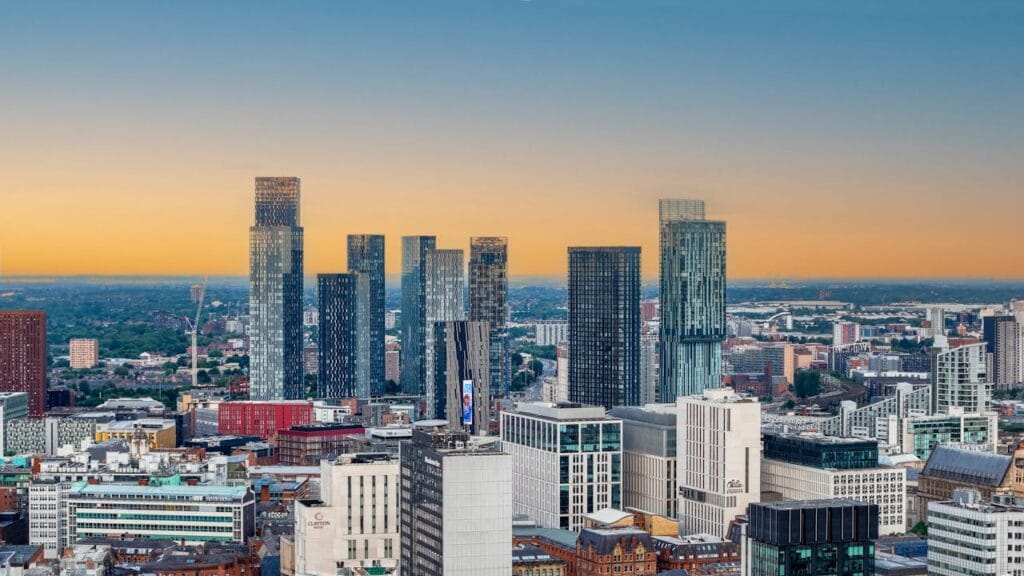

Manchester’s housing market looks set for another measured year of growth in 2026, with prices expected to increase by around 3% to 4% as limited supply continues to meet steady demand.
That outlook fits the wider picture emerging across the city: a market that is no longer racing ahead at the pace seen in previous peak periods, but one that still benefits from strong fundamentals, sustained buyer interest and an economy that continues to attract people, employers and investment. Recent ONS housing data for Manchester showed the average house price at £254,000 in January 2026, up 4.4% year on year, while Manchester City Council has also continued to highlight the pressure created by population growth and the need for more quality homes across the city.
Supply remains one of the biggest market pressures
A major reason Manchester is still expected to record house price growth is the basic imbalance between supply and demand. Even with new developments coming forward across the city, housing delivery has not fully caught up with the scale of need. City strategy documents continue to frame Manchester as a place with exceptionally high demand for homes across different tenures, and they also underline the long-term ambition to expand affordable housing provision. That matters because when supply remains tight, values tend to hold firmer even in a more cautious national market.
This is especially relevant in Manchester because demand does not come from just one buyer type. The city attracts first-time buyers, young professionals, families looking for strong transport links, and investors seeking long-term rental demand. As a result, even if some parts of the UK market cool, Manchester often retains a broader base of activity. That diversity gives the market resilience and helps explain why modest growth remains a realistic expectation rather than an overly optimistic one. According to TK Property Group, Manchester’s ongoing appeal lies in the combination of economic activity, regeneration and relative value when compared with higher-priced southern markets.
Demand is being supported by Manchester’s economic pull
Manchester’s property market is tied closely to the city’s wider economic performance. The city continues to benefit from major regeneration, a growing business base, university-driven demand and a reputation as one of the UK’s leading regional centres for employment and investment. These factors matter because housing demand tends to be strongest where job creation, infrastructure and inward migration support long-term occupancy.
Rather than relying purely on short-term sentiment, Manchester’s market is underpinned by structural demand. Buyers are not only looking at today’s mortgage conditions or this month’s asking prices. They are also considering the city’s future prospects, the pace of development in key areas and the enduring need for well-located homes close to transport, employment hubs and lifestyle amenities.
Some of the main forces helping to support demand include:
- continued population growth and household formation
- regeneration across central and fringe neighbourhoods
- strong appeal to graduates and young professionals
- sustained interest from landlords targeting rental demand
- better relative value than many southern cities
Together, those factors create an environment where house prices can continue to edge upward, even if the rate of growth stays moderate rather than dramatic.
A steadier mortgage backdrop is also helping confidence
Nationally, 2026 is widely being framed as a year of modest housing market growth rather than sharp acceleration. One major lender outlook published in January pointed to UK-wide growth of around 2% to 2.5%, with stronger performance expected in northern markets, while other forecasts have placed UK growth in a roughly 2% to 4% range as affordability gradually improves and rates become less disruptive than they were during earlier volatility. Manchester’s expected 3% to 4% increase sits comfortably within that broader outlook, but the city’s local dynamics mean it could outperform the national average if stock remains constrained.
This is an important shift from the past two years. The conversation is no longer dominated by severe uncertainty. Instead, the market appears to be moving into a more stable phase where buyers can make decisions with greater confidence. That does not mean affordability has stopped being a challenge, but it does suggest that the conditions for measured price growth are in place.
Why moderate growth may actually be a healthy sign
A rise of 3% to 4% might not sound dramatic when compared with the double-digit growth recorded in some previous market cycles, but for Manchester it could represent a healthy outcome. Rapid price inflation can create distortions, reduce accessibility and increase the risk of pullback. More moderate growth, by contrast, tends to signal a market supported by genuine need rather than speculation alone.
That kind of growth can also be more sustainable. It allows the city to keep attracting owner-occupiers and investors without creating the same level of overheating. It gives sellers confidence, but it also leaves room for buyers who still see Manchester as relatively accessible compared with other major UK urban markets.
There are several reasons this type of growth is significant:
- it suggests the market is holding up without relying on unsustainable momentum
- it reflects ongoing demand rather than short-lived hype
- it supports long-term confidence in the city’s housing sector
- it reinforces Manchester’s position as a strong regional market
In that sense, 2026 may be less about explosive growth and more about consolidation. For many parts of the housing market, that is a positive story.