
Political change in Westminster often creates uncertainty for financial and property markets. However, the reaction to Sir Keir Starmer’s announcement that he intends to resign as Prime Minister was notably restrained.
As reported in the Wall Street Journal’s coverage of the market response, investors had largely anticipated the change. Sterling and government bonds experienced only limited movement, suggesting that markets were waiting for policy detail rather than reacting dramatically to the political headline.
For Leeds, the transition could become more than a period of national political uncertainty. If the next government places greater emphasis on devolution, regional infrastructure and locally led growth, the city may be well positioned to secure further investment in housing, transport and regeneration.
The first signal was what did not happen
One of the most important features of the leadership change was the absence of an immediate financial-market shock. Political transitions can increase government borrowing costs, weaken sterling and affect confidence when investors fear abrupt changes to tax or spending policy.
That did not happen on a significant scale following Starmer’s announcement. The limited reaction indicated that the resignation had already been priced into expectations and that investors were more interested in the direction of the next administration.
Markets gained further reassurance when Andy Burnham, the leading contender to succeed Starmer, committed to maintaining the existing fiscal rules. Reuters reported that sterling edged higher after Burnham emphasised fiscal discipline and adherence to Labour’s 2024 manifesto framework.
For the property market, this matters because government borrowing costs influence wider interest-rate expectations and mortgage pricing. A transition that avoids severe disruption may allow investors, developers and buyers to continue assessing opportunities without waiting for an entirely new economic framework.
A northern leadership debate changes the conversation
The political transition is especially relevant to regional cities because Burnham has placed devolution near the centre of his emerging agenda. His proposals include giving mayors and local authorities greater influence over housing, infrastructure, skills and economic development.
The Guardian reported that the prospective leadership programme would pursue “good growth in every postcode” through a ten-year mission involving reindustrialisation, housing and infrastructure.
Although Burnham’s political base has been Greater Manchester, a more devolved national model would not need to benefit Manchester alone. West Yorkshire already has an established mayoral authority, an investment pipeline and several programmes requiring coordination between central government, regional leaders and private capital.
Leeds could therefore enter the next political period with many of the structures needed to respond quickly if additional powers or funding are transferred away from Whitehall.
Leeds already has a delivery vehicle waiting
The proposed Leeds Mayoral Development Zone could become one of the city’s most important tools for turning devolved policy into physical development.
The zone would cover a substantial part of central Leeds, with a major focus on South Bank and the land surrounding the railway station. It is intended to bring together Leeds City Council, the West Yorkshire Combined Authority, Homes England and other public and private partners.
According to Place Yorkshire’s reporting on the proposal, the development zone could support around 20,000 homes alongside employment space, public realm, cultural attractions and major transport investment.
The importance of the structure lies in coordination. Large urban projects can remain stalled when responsibility for land, funding, infrastructure and planning is divided between different organisations. A development zone could create a clearer route for assembling sites, prioritising investment and addressing viability problems.
South Bank could turn policy into property demand
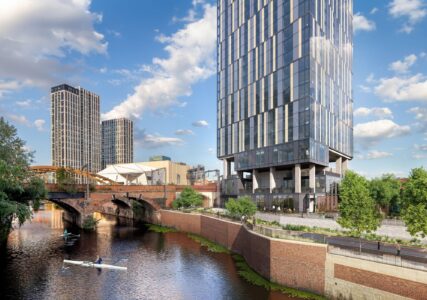
South Bank provides Leeds with the scale needed to translate regional growth policy into a new housing and employment district. The area includes former industrial and commercial land extending south from Leeds Station towards Holbeck, Hunslet and the Royal Armouries.
Major projects already progressing or proposed within the wider area include Aire Park, South Village, Sweetfields, Temple Works and the Royal Armouries Tiltyard. Together, these developments could extend the effective city centre and create new homes within walking distance of employment, culture and transport.
A recent £16 million funding package has moved South Village another step towards delivery. The scheme is expected to provide almost 2,000 homes, including affordable housing, on previously developed land.
If a future government gives regional mayors more flexibility over housing and infrastructure funding, schemes of this type could benefit. Roads, utilities, public spaces and transport connections often need public support before private residential development becomes viable.
According to TK Property Group, Leeds is particularly well placed to benefit from a stronger regional growth agenda because substantial regeneration plans are already moving towards delivery rather than existing only as long-term aspirations.