

The ideal scenario, in any type of investment, is to buy an asset or product cheaply in order to sell it at an appreciated value. This is true of both shares and commodities. But in the property market, how does this apply?
Finding a cheap property is not one of the easiest tasks. A house or flat generally loses value because its location has become undesirable, it did not receive proper maintenance, there is excess supply in the same region, or there are problems with the documentation.
This means that, to obtain a lower price, the investor accepts the property’s problems with the intention of solving them and recovering its value.
It is a risky strategy. In addition to requiring time and dedication to oversee building works and deal with unforeseen events, it brings the possibility that the costs of recovery will consume the discount obtained. To make matters worse, factors such as location and excess supply depend on changes in the market itself, which makes appreciation more uncertain.
But here is good news. Another way to buy at a lower price with a strong potential for capital growth is to purchase off-plan.
Buying off-plan means agreeing to buy a home before construction finishes, sometimes while it is still at the planning stage. Price is usually fixed at exchange, and early buyers get first choice of plot, floor, and layout.
Securing your spot
Reservation starts with the payment of a fee that takes the home off the market. Charges typically fall between £500 and £2,000, and the amount is usually deducted from the purchase price at completion.
Check the reservation agreement carefully before paying: it sets the deadline for exchanging contracts, often 28 days, and explains the refund terms if the transaction is cancelled before that point. At this stage, it is important to have the support of a solicitor specialised in off-plan purchases.
A little patience helps. Developers and builders will carry out identity, anti-money-laundering, and source-of-funds checks, which may take a few days. Ask the solicitor to walk through the price, specification, estimated completion window, and long-stop date (the deadline set for the handover of the property) before signing the contract.
Keeping your plans on track during construction
Construction brings a waiting period that can run from a few months to a few years, depending on how advanced the project is at exchange. Developer updates and occasional site visits keep a buyer in touch with progress, while safety rules limit access during building work.
Mortgage timing sits at the centre of this stage. Standard offers often remain valid for 180 days, while some new-build products allow up to around nine months. With construction still underway, these terms could expire before the property is ready. Many buyers therefore obtain an ‘agreement in principle’ early — an initial indication of how much a lender may lend — and submit the full application closer to completion.
As completion approaches, the lender may assess the property’s value again. If the valuation falls below the agreed purchase price, the mortgage amount may be lower than expected, so buyers should keep extra funds available to cover the difference.
Changes to personal circumstances, lending criteria, or interest rates between exchange and handover can also alter the terms on offer, so keeping finances steady through the build is paramount.
Snagging: checking the finished home
Snagging is the opportunity to inspect the finished home and flag defects or unfinished work for the developer to address. Once the property is ready and the required approvals are in place, the builder issues a notice to complete. This sets the deadline for transferring the remaining funds, often around 10 working days, with the exact period specified in the contract.
Use that time for a thorough inspection of doors, windows, paintwork, finishes, appliances, and outside space. Record every defect in writing, with dates and photographs, and agree a timetable for the builder to put each item right. A professional snagging survey can add an independent eye, particularly where someone is buying from a distance or as an investment.
Completion and life after the keys
Completion day brings the balance payment, legal transfer of ownership, and the keys. Solicitors register the purchase, and the buyer takes responsibility for the home from that point.
Most new properties carry a 10-year warranty. Under NHBC Buildmark, the builder rectifies defects linked to workmanship and materials during the first two years, and insurance cover applies to structural faults in years three to 10. Buyers of flats should also check lease terms, service charge budgets, and the management arrangement, since those costs continue after completion. Home insurance sits separately from a structural warranty.
A purchase planned around deadlines
Off-plan buying suits a buyer with patience, a clear cash plan, and a preference for a new home with modern specifications, energy efficiency, and a chain-free purchase. It rewards early choice and staged instalments, and it asks for careful reading of deadlines, payment schedules, and warranty cover.
Three questions give a strong start:
- Is the price fixed at exchange?
- What is the long-stop date?
- What does the warranty cover in years one, two, and 10?
Answers to those questions, checked by a solicitor before reservation, turn a set of plans into a purchase a buyer can rely on.
Have questions about the process or are still unsure about any of the details mentioned above? Contact us today to speak to one of our property investment consultants.


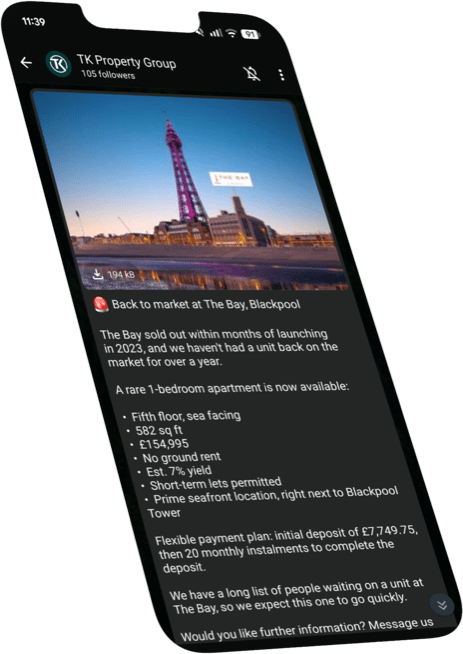


 New development launches